
Key Takeaways
- There’s no universal winner in the open office vs cubicle debate: each serves different needs.
- Open-plan offices encourage collaboration but can increase noise and distraction.
- Cubicles support privacy and focus, often boosting productivity for heads-down work.
- Many companies now choose a hybrid layout combining both styles.
- The best choice depends on your workflow, culture, and space constraints.
If your work culture relies heavily on collaboration, conversation, and rapid problem-solving, an open-plan office likely fits better. If your team performs focused or confidential work or struggles with distractions, a cubicle layout is often the better option.
But today, most organizations benefit from a hybrid approach, mixing shared collaborative zones with cubicle or private spaces for deep work. In this guide, we’ll take a closer look at each option so that you can decide which layout will work best for your space.
Why This Debate Exists in the First Place
The past two decades saw a massive shift toward open-plan spaces, seen as cheaper, more modern, and more collaborative. Cubicles were marked as relics of the past: stale, isolating, and rigid. Then reality kicked in. Teams discovered that while open layouts look fun and flexible, many employees found it harder to concentrate amid constant chatter and visual interruptions.
Today, the cubicle vs open office debate is less about style and more about performance: Which setup helps people do their best work?
Let’s break down both sides.
What Is an Open-Plan Office?
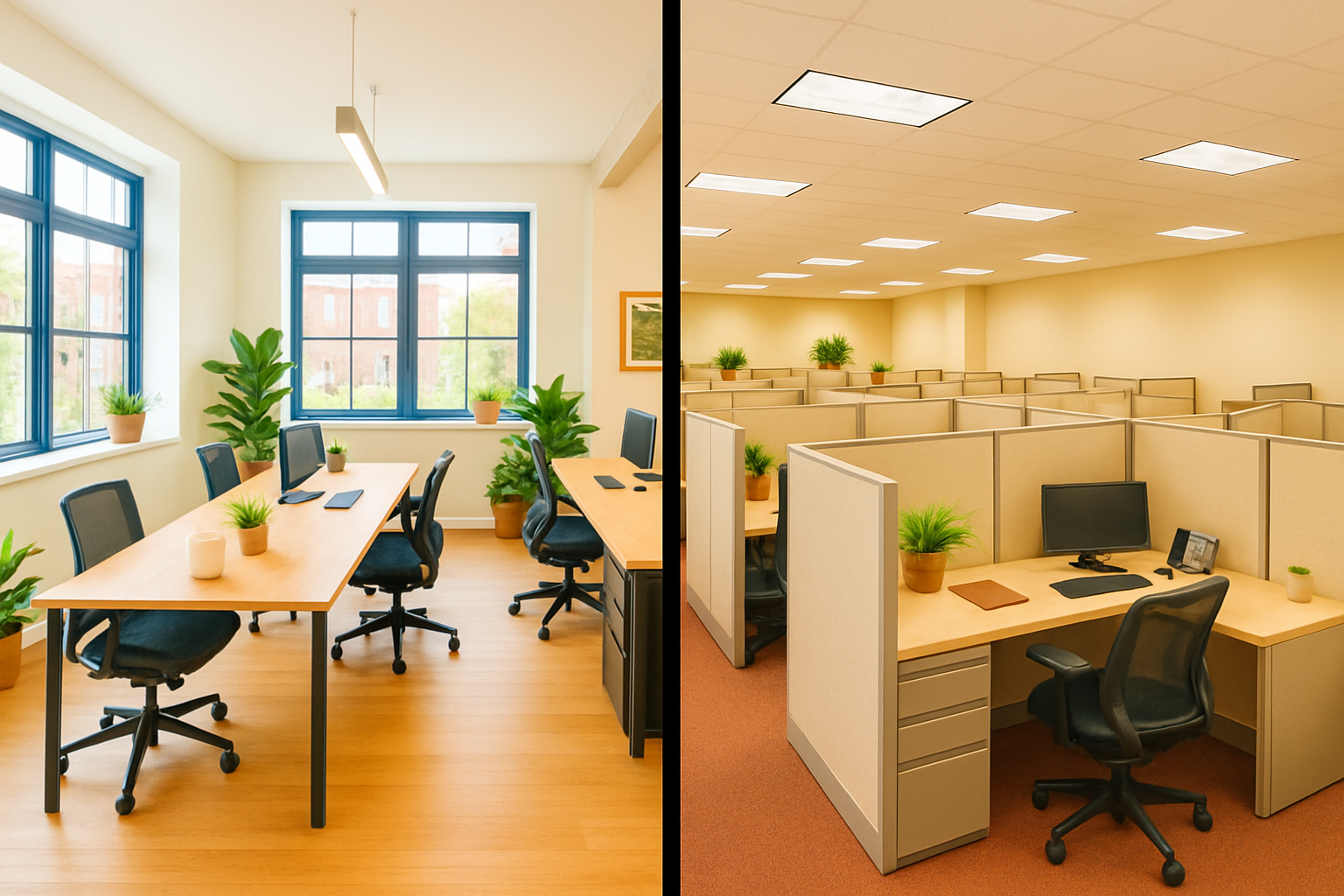
An open-plan office removes walls and divides people less, clustering employees into shared space. Teams sit at long benches, clusters of desks, or communal tables. Barriers, from panel dividers to private offices, are minimal.
In practice, it feels informal, open, and flexible. The space is designed to allow people to interact freely and quickly.
Advantages of an Open-Plan Office
Easier Collaboration
One of the biggest advantages of an open office is how easily people can share ideas. Without high panels or closed rooms between teams, conversations happen naturally: a quick question, a spontaneous brainstorm, a hallway chat that sparks a new solution.
For groups who rely on constant communication (like product development, marketing, design, and early-stage startups), this setup can speed up decision-making and help everyone stay aligned. Collaboration doesn’t require scheduling a meeting; it happens as part of the flow of the day.
Flexible Space Planning
When comparing cubicle vs open office, open-plan layouts tend to win on flexibility. Need to add seats for new hires? Shift a team across the room? Rearrange tables for a project sprint? You can usually update the layout in minutes.
This adaptability makes open spaces especially appealing for fast-growing companies, seasonal teams, or project-based organizations that frequently regroup and reorganize. Instead of reinstalling wall panels or moving furniture around a maze of workstations, you can simply slide desks and chairs to create a new layout.
Lower Construction Cost
In many cases, an open-plan office costs less upfront. Fewer physical dividers and built-out private areas mean less material and labor during construction. There’s also less long-term maintenance; you’re not repairing broken panels or replacing multiple enclosed rooms as your office evolves.
This budget-friendly setup can free up resources for other workplace investments, like technology upgrades or ergonomic seating. It’s part of why startups often begin with open layouts: they get a functional workspace without major build-out expenses.
Modern Look
Open-plan spaces often feel bright and inviting. With fewer barriers, natural light travels farther, sightlines expand, and the overall environment feels more relaxed and contemporary.
Companies that embrace a modern brand identity (especially in tech and creative industries) often use open offices as part of their cultural signal: “We’re collaborative, transparent, and modern.” The look and feel alone can help with recruiting talent who appreciate a space that feels social and energetic.
Even small touches, like airy seating zones or shared standing tables, can shape a workplace that feels less rigid than traditional cubicle layouts.
Disadvantages of an Open-Plan Office
- More Noise + Distraction: The biggest complaint. Conversations, movement, ringing phones; constant background activity can make it hard to focus.
- Reduced Privacy: Sensitive calls, personal conversations, or confidential tasks are challenging without a private zone.
- Harder Deep Focus: Engineers, writers, analysts, and finance workers often need quiet time. Open layouts can hinder that.
- Potential Health + Burnout Risk: Research shows employees in open workplaces take more sick days and report higher stress due to noise and lack of privacy.
What Are Cubicles?
Cubicles divide space with panel walls that create semi-private workstations. They balance structure and flexibility so you get a defined personal space without needing full offices. Today’s cubicles look nothing like those from the ’80s. Modern call center cubicles, for example, offer modular layouts, clean design, and fast assembly.
Advantages of Cubicles
Privacy & Focus
Panel walls give employees a quiet corner of their own. Visual and acoustic separation means fewer interruptions from office chatter or passing colleagues, making it easier to dive into complex projects or focus on sensitive work. Instead of being pulled in every direction, people can settle in and actually get things done.
Defined Personal Space
Cubicles create a clear boundary for each person, which makes it easier to organize, personalize, and feel at home at work. Whether it’s arranging tools, displaying photos, or keeping a favorite mug within reach, having a space that feels like your own can make the day a little more comfortable, and satisfaction usually follows.
Fewer Distractions
High panels help block out movement, side conversations, and other interruptions that can break concentration. Employees can keep their attention on the task at hand without constantly refocusing, which can make the workday feel smoother and less stressful.
Better for Confidential Work
For roles that handle private information, like HR, finance, legal, or support, panels provide a safe, quieter environment. Phone calls, paperwork, or sensitive discussions can happen without worry, helping employees feel secure and confident that their work stays private.
Disadvantages of Cubicles
- Limited Spontaneous Collaboration: You can still collaborate, but you’re less likely to overhear conversations that spark ideas.
- Potential Isolation: Some employees may feel separated from teammates, especially new hires with fewer relationships.
- Less Open Aesthetic: Cubicles make a space feel structured rather than “loft-like” or relaxed.
Meeting in the Middle With Hybrid Office Layouts
Most modern teams don’t fit neatly into the debate of open office vs cubicle. Work is diverse, and different tasks demand different environments. That’s why many companies are embracing hybrid layouts, combining the best elements of both styles to support productivity, focus, and collaboration.
A hybrid office might include:
- Cubicles for concentration: When employees need to focus on detailed projects or handle sensitive work, a semi-enclosed space provides the quiet and privacy that open areas can’t.
- Open areas for collaboration: Creative brainstorming, quick questions, or team problem-solving happen naturally in shared spaces where communication flows freely.
- Huddle rooms for meetings: Small, private rooms give groups a place to strategize or meet without disturbing others in the office.
- Quiet rooms for privacy: Phone calls, confidential discussions, or deep focus tasks get their own dedicated space when needed.
This approach solves the classic cubicle vs open office debate by recognizing a simple truth: different work styles need different environments. Creative collaboration doesn’t thrive in a closed cubicle, and confidential paperwork isn’t ideal in a busy open-plan office.
Quiz Time: Choosing the Right Layout for Your Space
Start with a few questions:
1) What kind of work do people do?
- Focused → Cubicles
- Collaborative → Open-plan
2) How much privacy is necessary?
- High → Cubicles
- Low → Open
3) What’s your culture?
- Social → Open
- Independent → Cubicles
4) Do you grow/reorganize often?
- Modular cubicles or flexible open spaces both work
5) Noise tolerance?
- Low → Cubicles
- High → Open
A Quick Suggestions Reference
| Role Type | Better Fit |
| HR, Finance, Legal | Cubicle |
| Designers/Marketing | Either |
| Engineering | Cubicle |
| Sales Floor | Open |
| Support/Call Center | Cubicle |
| Leadership | Either |
| Admin | Either |
Open-Plan Office vs Cubicle: Final Verdict
There isn’t a single “right” answer here, only what’s right for your people and the work they’re doing.
Most workplaces now sit somewhere in the middle: open areas for collaboration, quieter zones or cubicles for deep work, and shared spaces that flex with shifting priorities. It’s less about choosing sides (cubicle vs open office) and more about building an environment that supports different types of work throughout the day.
If you’re looking to explore options, from flexible benching layouts to modern, modular cubicles, SUNLINE Office can help you design a space that fits your workflow, your culture, and your budget. Shop our cubicle systems today!